Guide for agencies

White-label AI voice agents: build, rent or done for you?

An agency can sell white-label AI voice agents in three ways: rent a DIY platform and run the agents itself, buy a done-for-you service where the provider operates everything, or hire a build partner who builds the agent under your brand and hands it over. The right choice depends on who you want answering when something breaks.

We are a build partner, so we have a stake in this. Halyard Ops is a new studio with no client results yet. The guide says where each option fits best, including when that is not us.

What are the three ways to sell white-label AI voice agents?

The useful question is not which brand, but who operates the agent after launch. Pages that say "white-label voice AI" can describe any of these three:

  • A DIY platform. You get a console, client sub-accounts and your own branding. You design, build, test and support each agent yourself.
  • A done-for-you service. The provider runs the voice engine, the phone setup, the tuning and the uptime. You sell the finished agent under your brand.
  • A build partner. The partner builds the agent inside your accounts, under your brand, and hands it over with documentation. After that you run it, or pay for optional care. This is what Halyard Ops does.

This is our own way of grouping the options, not a survey of providers. The labels are used loosely, so check which one a provider really is. Ask one question: if the agent fails at 2 AM, who gets the alert and who fixes it?

How do the three options compare?

How we see the three models: our judgment, not a survey of providers. Check each provider's terms.
QuestionDIY platformDone-for-you serviceBuild partner (our model)
Who builds the agentYouThe providerThe partner, in your accounts
Who runs it after launchYouThe providerYou, or the partner under optional care
Who holds the accounts and the agent's settingsCan be the platform vendor, with your clients as sub-accounts. Ask who.Can be the provider. Ask who.You
Where your time goesBuilding, testing and supportingSelling and managing the relationshipSelling, plus calls during the build
Main riskYou carry the design, testing and support, and the platform's limitsYour client may depend on one provider's uptime and termsYou depend on the quality of the build and the partner's care, and you run it after handover. Halyard Ops is new and has no track record yet.
Best whenYou have a technical person and want control of every settingYou want to sell fast and operate nothingYou want to own the agent without building it

Which option fits which agency?

  • Choose a DIY platform if you have someone technical, many small clients and the time to support them.
  • Choose done-for-you if you want to add a service line quickly and are comfortable depending on the provider for uptime and changes.
  • Choose a build partner if you have a few clients who pay for something tailored, you want to own the agent and the accounts, and you can run it after handover or pay for care.

Agencies can switch models later. Holding the accounts and the agent's settings yourself makes that move easier, so ask about ownership first.

What should an agency ask any provider before signing?

  • Who owns the accounts, the prompts and the call recordings if we leave?
  • Who gets the alert when a call fails, and how quickly is it fixed?
  • What does the agent say about prices, advice and emergencies, and who approves that wording?
  • Where are recordings and transcripts stored, for how long, and can we delete them?
  • Are call minutes billed to us directly, and is there a markup?
  • Can we hear a recorded test with our own sample lead before we sign?
  • Is there an NDA before we share client details?

How can you test a provider's claims?

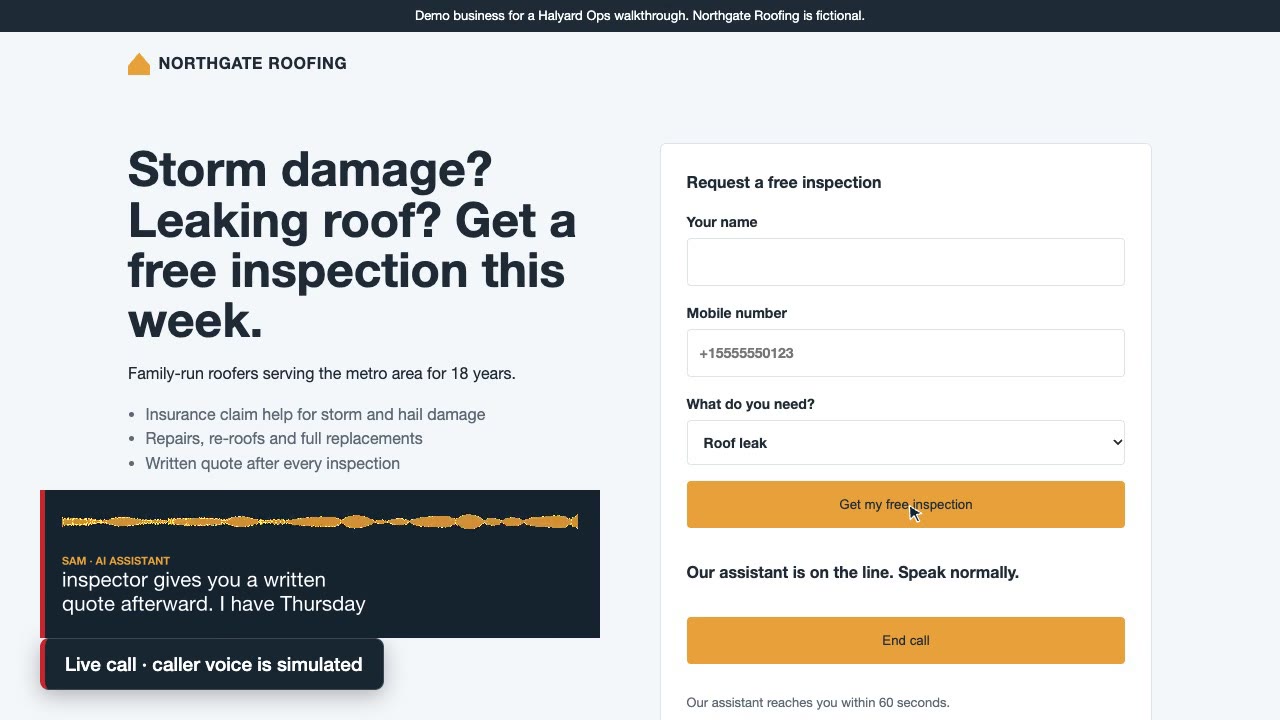
Provider pages quote launch times, costs and results that are hard to check from a web page. Run one sample lead through the agent instead: submit a form with your own phone number, note how quickly the call starts, and listen to what the agent asks and what it refuses to say.

In our own demo build the AI's call started 1.1 seconds after the form was sent. That was one test on a fictional business, not a client result. If you want a timed test on your own sample lead, ask us on the call; we will say what we can run before you sign.

Where does Halyard Ops fit?

We are a build partner, and a new one: the only build so far is a demo on a fictional roofing company. We build the speed-to-lead voice agent in your accounts under your brand, hand it over with a recorded walkthrough, notes and test cases, and never contact your client. We do not run a platform and we do not resell call minutes.

If you want a self-serve console, or a provider that operates everything, one of the other two options fits better and we will say so. For how a build works, see white-label AI voice agents for agencies.
FAQ

Questions agencies ask about the three options

Something else on your mind? Email us

Which option is cheapest?

It depends on how many clients you have and how much of your own time you count, and provider prices change often, so we do not quote any. Compare the total: platform or service fees, call minutes, and the hours you spend building and supporting. Ask each provider for a written price.

Can we switch from one model to another later?

In principle, yes. It is easier when you hold the accounts and the agent's settings. Ask each provider who owns them before you sign, because that decides how hard a move is.

Who owns the agent in a build-partner arrangement?

With Halyard Ops, you do. We build in your accounts, and you receive the notes, the walkthrough video and the test cases.

Do my clients need to be told it is an AI?

That is a question for your counsel. We recommend saying so at the start of the call, and by default our demo agent says it is an AI if asked. US rules treat AI-generated voices as artificial voices, which generally require the called person's prior consent for these calls (FCC declaratory ruling, February 2024), and state rules differ.

Contact

Tell us what's slipping.

Book a 15-minute call, or email us the business and the problem. We reply within one business day with whether we can help and a fixed quote for a first build.