Why do new-patient inquiries go cold?
A new patient finds your practice online and sends a request in the evening. Your front desk is closed, or busy with the people in the chairs, and the request can wait until the next day.
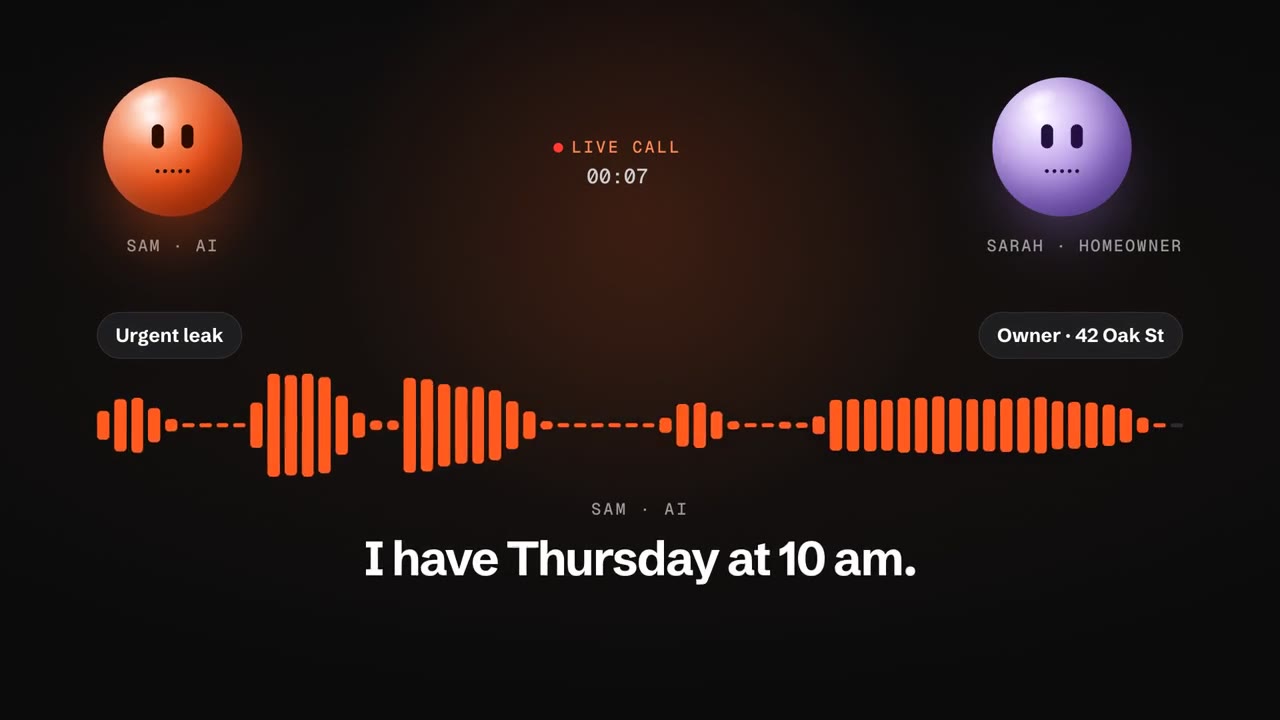
Many people contact more than one practice, so a fast first call may help. We have no client data yet. The agent is meant to cover the gap between "request received" and "someone called", and to pass anything that needs a person to your team.
What does the agent do with a new-patient inquiry?
- Is set up to call the new patient when the web form is sent.
- Introduces itself as your practice's assistant. By default it says it is an AI if asked; we recommend saying so in the opening line too.
- Is set up to ask only what it takes to book: name, best phone number, whether they have been to your practice before, the kind of visit (exam, cleaning, something hurts, cosmetic consult) and a preferred day and time.
- Offers an open appointment time and books it only after the caller clearly agrees.
- Records the request and tells your front desk what to expect, so a person confirms and takes over. Whether it books directly depends on your practice management system; the fallback is a shared calendar, or a booking request that your front desk confirms.
Visit types, wording and what counts as urgent are yours to set. We agree them with you on the first call.
What would the agent be told not to do?
These are instructions, not guarantees, and no dental agent has been built or tested yet. We would test them with fictional patients, including callers who push for advice, and show you the recordings before go-live. AI can still make mistakes, so we recommend your front desk reviews early calls.
- Give clinical advice. It is told not to say what might be wrong, whether to wait, or what to take, and not to judge how serious a symptom is. Anything about symptoms goes to your team.
- Quote treatment costs or promise insurance coverage. Your front desk handles money and benefits.
- Collect more than booking needs. It is told not to ask for dates of birth, medical history, insurance ID numbers, Social Security numbers or card numbers. Those belong on your own secure intake forms. If a caller volunteers more, it can end up in the call record, so the BAA and retention terms matter.
- Handle an emergency on its own. If a caller mentions severe pain, swelling, bleeding or trouble breathing, the plan is that it says "if this is an emergency, call 911" and passes the call to your on-call line. We set the exact trigger wording with your dentist. This has not been tested with a dental practice yet.
- Call people who have not asked. It is designed to call only someone who has just submitted your form with a phone number. Whether your form wording gives legal consent for an automated or AI-voice call is for your counsel to confirm, and we do not switch calls on until you confirm. We do not build agents that cold-call lists, and we do not build agents that pretend to be human.
What does HIPAA mean for an AI voice agent at a dental practice?
Plain-language notes, not legal advice. Written by Halyard Ops, which is not a law firm; not reviewed by counsel. A HHS tag means the point comes from the US Department of Health and Human Services' own guidance. A Our judgment tag means it is ours. Your privacy officer or counsel has the final say.
- Does it apply to you?
Our judgment HIPAA covers health care providers that transmit health information electronically in connection with certain standard transactions, such as insurance claims; HHS calls these covered entities. Most practices that bill insurance electronically are covered. Check your own status.
- Is a new-patient inquiry protected health information?
Our judgment Treat the details a person gives you about their care, together with their name and phone number, as protected from the moment your practice has them.
- Who needs a business associate agreement (BAA)?
HHS A vendor that creates, receives, maintains or transmits protected health information for you is a business associate, and you need a signed BAA before sharing it. Subcontractors count too, and HHS's own examples include a third-party chatbot that handles things like appointment scheduling. Our judgment For a voice agent, that chain can include the voice platform, the phone provider, the AI model provider and anyone who can open recordings or transcripts. Each needs a BAA on the plan you actually use. HHS limits the conduit exception to carriers that only transmit information, so a platform that records or stores calls is the kind of vendor to check.
- Has anyone checked that chain for this agent?
Our policy Not yet. We have not confirmed which voice platform, phone provider and AI model provider will sign a BAA on a plan a small practice can use. We will confirm that before we quote a dental build, and we will tell you if no workable chain exists.
- What about cloud tools?
HHS A cloud provider that holds this information for you is a business associate even if it cannot read the data, for example because it lacks the encryption key.
- How much should the agent ask for?
HHS Covered entities must take reasonable steps to limit the use and sharing of protected health information to the minimum needed for the purpose, with some exceptions. Our design The agent is built to ask only what booking needs. Whether that meets the rule for your practice is for your privacy officer to decide.
- Does “built in your accounts” solve it?
Our judgment You own the accounts and the contracts, which also means getting each vendor's BAA on the plan used. It does not make a setup compliant by itself, and no tool is “HIPAA compliant” on its own. It depends on how the whole arrangement is used.
- What do we do ourselves?
Our policy During the build and testing we use fictional patients only. We do not touch real patient information until the BAA chain is signed. If we ever have access to real calls or transcripts, for example in monthly care, we would be a business associate and need a BAA with you first. Without one, we do not take that access.
- What about call recording and AI-voice rules?
Our judgment Call-recording rules vary by state. US federal rules treat AI-generated voices as artificial voices, which generally require the called person's prior consent (FCC declaratory ruling, February 2024). The agent is designed to call only people who submitted your form, and the disclosure wording is set with you and checked by your counsel.
Sources: HHS, Business Associates FAQs; HHS, Guidance on HIPAA and Cloud Computing; HHS, Minimum Necessary Requirement. Read on 14 November 2026. We did not have these notes reviewed by counsel.
How does a build work?
- Scope. A 15-minute call. No patient information needed. We cover your tools, which visit types you book, your emergency rules and who owns privacy decisions. Ask that person about the BAA chain now. A fixed quote within two business days.
- Build. We build the agent in your accounts and test it with fictional patients: a new-patient exam, a caller in pain, a caller who asks for advice, a caller who asks whether it is an AI, a number that is not theirs.
- Hand over. A recorded walkthrough, notes, the test cases and a one-page list of what the agent collects, where it is stored and which vendors touch it, for your privacy officer to review.
- Go live. Only after your sign-off and a signed BAA chain. Optional monthly care follows, under a BAA if it needs access to real calls.
We have not built a dental agent yet and have not confirmed which vendors will sign BAAs, so we confirm a workable BAA chain before we quote a dental build. Once that is settled we plan for one to two weeks of build time. Signing the BAAs depends on the vendors and sits outside that.
Is it right for your practice?
A good fit
- New-patient inquiries reach you by web form or ads
- Your front desk is busy or closed when they arrive
- Someone on your team owns privacy decisions and can sign BAAs
Probably not yet
- You want the AI to give clinical advice or triage symptoms
- You want it to read patient records or check insurance. We do not build that yet
- The tools you use will not sign a BAA
After-hours and overflow answering can be scoped on a call. It handles more patient information, so the same BAA checks come first. Run a marketing agency for dental practices? A build through an agency puts the agency in the BAA chain too, so ask us first. Background: white-label AI voice agents for agencies and the guide to done-for-you vs DIY white-label voice agents.